Bookmark and Share
Showing posts with label Glycemic Control. Show all posts

Friday, May 6, 2011

Analysis Shows Value of Structured Exercise Programs in Diabetes Care

Insurance Benefits for Exercise Programs Can Cut Health Costs
----------------------------------------------------
FOR the person with type 2 diabetes, or the high-risk individual who is trying to prevent the development of diabetes, there is an enormous body of research literature documenting the benefits of exercise. Indeed, research shows that just six weeks of exercise is enough to change both brain chemistry and body chemistry for the better; diets alone don’t have the same effect. But some questions still remain ‒ how much exercise is needed, and what kind?

A host of studies have linked exercise programs with improved health measures related to blood pressure, lipid levels — including cholesterol and triglycerides — cardiovascular events, cognition, physical performance, premature death and quality of life. Analyses of interventions to promote physical exercise in adults have found that compared with no intervention, exercise programs are cost-effective and have the potential to improve survival rates and health-related quality of life.

A recent systematic review and meta-analysis ‒ undertaken by scientists led by Daniel Umpierre of the Hospital de Clinica de Porto Alegre in Brazil ‒ compares the association between physical activity advice and structured exercise programs, respectively, and markers of diabetes. It reveals that implementing structured exercise training — including aerobic, resistance or both — is associated with a greater reduction in HbA1c levels for patients with diabetes compared to patients in control groups. Results of the study are published in the May 4 issue of the Journal of the American Medical Association (JAMA).

A structured exercise is a task, activity, or question posed by a leader that pushes everyone to reflect, focus, offer ideas and insights, and become engaged in learning. Structured exercises offer group leaders a variety of options for encouraging group participation and discussion, practicing skills, and involving adults who have a range of learning styles and capabilities.

After analyzing the results of 47 randomized clinical trials, the researchers also found that exercising for longer periods of time was better at bringing blood sugar levels down than exercising more intensively. Longer weekly exercise duration was also associated with a greater decrease in these levels, according to results of the analysis of previous studies.

The meta-analysis shows that greatest reductions in HbA1c occurred in patients exercising for more than 150 minutes in total per week. Exercise intensity did not appear to matter. Exercising a minimum of 150 minutes a week (usually broken down to 30 minutes of exercise five days a week) is recommended by such institutions as the American College of Sports Medicine.

"People with type 2 diabetes should engage in regular exercise training, preferentially supervised exercise training," says Beatriz Schaan, the study's senior author. "If these patients can perform training for more than 150 minutes per week, this would be more beneficial concerning their glucose control. However, if they cannot reach this amount of weekly exercise, lower exercise amounts are also beneficial."


A recent joint statement from the American Diabetes Association (ADA) and the American College of Sports Medicine (ACSM) has already underscored the importance of physical exercise to prevent and manage insulin resistance, type 2 diabetes mellitus, gestational diabetes mellitus, and the complications of diabetes.

“Current guidelines recommend that patients with type 2 diabetes should perform at least 150 minutes per week of moderate-intensity aerobic exercise and should perform resistance exercise three times per week,” the authors of the Brazil study wrote. “Regular exercise improves glucose control in diabetes, but the association of different exercise training interventions on glucose control is unclear.”

Indeed, although some clinical trial evidence suggests that aerobic exercise and resistance training can each improve glucose control in patients with type 2 diabetes mellitus, not all clinical trials are consistent with regard to this finding.

However, differences in results of clinical trials about the ability of aerobic exercise and resistance training to improve glucose control are primarily due to differences in trial design, including modality, intensity, exercise program duration, adherence to the programs, sample size, and patient populations.

In the Brazilian study, the authors analyzed 47 randomized controlled trials (RCTs) into the effect of exercise on HbA1c, with a total of 8538 patients. In 23 of these RCTs, patients took part in structured exercise training, and in the other 24 they were simply given advice on physical activity.

Across all studies analyzed, engaging in structured exercise was associated with decreased HbA1c levels compared with controls, whether this was structured resistance training (fall in HbA1c of 0.57%), structured aerobic exercise (fall of 0.75%), or a combination of both (0.51% fall).

A longer total time spent in structured exercise was associated with better glycemic control. If total weekly time in structured exercise exceeded 150 minutes, the average drop in HbA1c was 0.89%, against 0.36% for a time of 150 minutes or less.

Physical activity advice was only associated with a decline in HbA1c if it was combined with dietary advice.

The authors said: “This systematic review and meta-analysis of RCTs demonstrates important findings regarding the prescription of structured exercise training. First, aerobic, resistance, and combined training are each associated with HbA1c decreases, and the magnitude of this reduction is similar across the three exercise modalities.

“Second … structured exercise of more than 150 minutes per week is associated with greater declines in HbA1c than structured exercise of 150 minutes or less per week in patients with type 2 diabetes. This finding is important because the current guideline-recommended exercise duration is at least 150 minutes per week.

They added: “Although high-intensity exercise has been previously shown to have an association with HbA1c reduction, our findings did not demonstrate that more intensive exercise was associated with greater declines in HbA1c.”

In an accompanying editorial, Marco Pahor, director of the University of Florida Institute on Aging, argues that “the meta-analysis … and cumulative evidence from a large number of randomized controlled trials conducted over the past few decades in the area of physical activity and exercise provide solid evidence for public policy makers to consider structured exercise and physical activity programs as worthy of insurance reimbursement to promote health, especially in high-risk populations.”

Insurance Benefits for Exercise Programs Can Cut Health Costs
With respect to type 2 diabetes, Medicare reimburses for approved self-management education and medical nutrition therapy programs. But no specific reimbursement is given for any physical activity or exercise program, despite evidence that such programs can help improve health and cut costs.

Questions remain as to what format reimbursable exercise and physical activity programs should take, what population group should be targeted, and at what stage of life or health status would a lifestyle intervention be most cost-effective to implement.

Some insurance providers already include a fitness benefit for members, such as monthly membership at certain fitness centers or access to personal trainers or exercise classes at reduced cost. Indeed, use of such health plan-sponsored club benefits by older adults has been linked to slower increases in total health care costs.

In one study, older adults who visited a health club two or more times a week over two years incurred $1,252 less in health-care costs in the second year than those who visited a health club less than once a week. Programs among people with lower incomes can also pay off, because people in that group are otherwise more likely to forego health-promoting physical activity because of economic constraints or safety concerns.

“People are willing to invest in improved health, but if you have a fixed amount of resources then you want to choose where you get the most health for the dollar,” said Erik Groessl, an assistant professor of family and preventive medicine at the University of California, San Diego, and director of the UCSD Health Services Research Center. Groessl was not involved in the current analysis.

Group training or walking programs, for example, can be cost-effective, sustainable forms of physical activity that don’t require expensive health care professionals or equipment. But more costly interventions that yield dramatic results might also be worth the expense.

“There is a lot of evidence that physical activity works, and I think it’s time to start putting it into practice more widely,” Groessl said.

Sources: JAMA, University of Florida News, Medpage Today

Wednesday, May 4, 2011

Poor Sleep Quality In People With Diabetes Leads To Poor Blood Sugar Control

• Do you have difficulty falling or staying asleep?

• Are you excessively sleepy during the day or fall asleep when you don't want to?

• Do you snore or have you been told that you snore loudly?

• Do you gasp for air or have you been told that you stop breathing during sleep?

• Do you experience uncomfortable sensations in the legs in the evening that are relieved by movement?

• Are you a restless sleeper or have you been told that you kick during sleep?


SLEEP disturbances are common and can be detrimental to the health, mood, and quality of life of people with diabetes. Sleep-disordered breathing, pain, restless legs syndrome, primary insomnia, and lifestyle factors all contribute to a high rate of sleep complaints in this population.
Because the etiology of poor sleep quality is often multifactorial and may shift over time, a careful evaluation for insomnia, sleep-disordered breathing, and restless legs syndrome should be an integral part of the routine care of patients with diabetes, say experts.

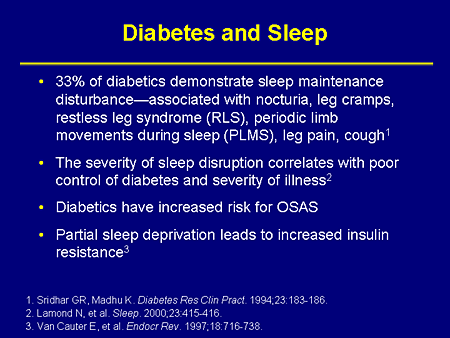
Generally, people with diabetes have poorer sleep than non-diabetics. Also, poor sleep has been proposed as a risk factor for developing the disease. Sleep disorders, such as obstructive sleep apnea, are more prevalent in people with type 2 diabetes. Therefore, it is not surprising that up to 71% of this population complain of poor sleep quality and high rates of hypnotic use.

Diabetes is worse when combined with insomnia symptoms. In fact, insomnia makes most medical diseases much worse in ways that are only just being found out and can chemically disrupt the body’s insulin balance enough to even be a root cause for certain types of diabetes, say experts.

Insomnia-Insulin Resistance Link

In the largest study of its kind to establish a link between sleep and diabetes ‒ published in the June issue of Diabetes Care ‒ researchers have found that people with diabetes who sleep poorly have higher insulin resistance, and a harder time controlling the disease.

"Poor sleep quality in people with diabetes was associated with worse control of their blood glucose levels," says Kristen Knutson, PhD, assistant professor of medicine at the University of Chicago Medical Center and lead author of the study.

"People who have a hard time controlling their blood glucose levels have a greater risk of complications. They have a reduced quality of life. And, they have a reduced life expectancy," she explains in apress statement.

Multiple factors contribute to insomnia complaints in patients with diabetes, say Phyllis C Zee, and Erik Naylor in their expert columnin Medscape. In type 1 diabetes, rapid changes in glucose levels during sleep have been postulated to cause awakenings. For individuals with type 2 diabetes, sleep disturbances may be related to obesity or obesity-associated sleep disorders, such as sleep apnea.

Sleep-disordered breathing correlates highly with obesity in the diabetic population. A strong association also exists between obesity, impaired glucose tolerance, insulin resistance, and sleep-disordered breathing.

Furthermore, the severity of sleep-disordered breathing, as measured by the apnea-hypopnea index, correlates with the severity of glucose intolerance, insulin resistance, and diabetes. Although obstructive sleep apnea is the most common type of sleep-disordered breathing, central-type apneas and periodic breathing have been reported in patients with autonomic diabetic neuropathy.

The Chemistry of the Sleep-Wake Cycle 

Since diabetics are sensitive to blood glucose levels and chemical balances in the body, it’s illustrative to explore just how detrimental disruptions in the sleep cycle can be. Studies have shown that diabetes worsens when adult sufferers sleep less than 6 hours per night or more than 9.

The loss of normal sleep hours or addition of sleep hours seems to undo the body’s chemistry and completely throw off-balance the blood glucose levels. Doctors don’t know for sure the exact chemistry behind this phenomenon outside of the observation. This underscores the importance of the sleep cycle chemistry.

In Knutson’s study, for example, among the diabetics, poor sleepers had 23% higher blood glucose levels in the morning, and 48% higher blood insulin levels. Using these numbers to estimate a person's insulin resistance, the researchers found that poor sleepers with diabetes had 82% higher insulin resistance than normal sleepers with diabetes.

Other studies have shown that chronic insomnia in healthy people can also instigate diabetes. Loss of sleep interrupts insulin balance—leads to insulin resistance—which in turn can lead to more severe medical problems and Type 2 diabetes.

Diabetes Management

Much of the challenge for diabetics is proper and long-term management of their diabetes. When the sleep-wake cycle is also mismanaged, so too is the diabetes. Like many other medical diseases and conditions, diabetes is sensitive to sleep disturbances. But insomnia, as a set of symptoms, is usually secondary to something else.

Insomnia is characterized in a number of ways: you could have problems going to sleep (sleep onset insomnia), problems waking up and going back to sleep (middle of the night insomnia), or waking up in the early dawn unable to return to sleep that night (terminal or late insomnia). Doctors can often associate particular patterns of insomnia such as these to particular medical problems.

Insomnia is rarely treated as a primary affliction. In most medical sectors it’s important to identify and diagnose insomnia for its implication in other problems, including depression, a common secondary illness to diabetes. As patients get older, the risk for depression escalates. Loss of a loved one, stress, anxiety and a range of other social disturbances can set in motion the symptoms for chronic insomnia. Loss of sleep makes for haywire blood sugar.

The Way Forward

Knutson says the next step for researchers is to see if treating poor sleep can improve long-term outcomes and quality of life for diabetics. "For someone who already has diabetes, adding a sleep treatment intervention, whether it's treating sleep apnea or treating insomnia, may be an additional help for them to control their disease," she points out.

In fact, restoring a healthy amount of sleep may be as powerful an intervention as the drugs currently used to treat type 2 diabetes. "This suggests that improving sleep quality in diabetics would have a similar beneficial effect as the most commonly used anti-diabetes drugs," says Eve Van Cauter, PhD, professor of medicine and co-author of the study.

"For someone who already has diabetes, adding a sleep treatment intervention, whether it's treating sleep apnea or treating insomnia, may be an additional help for them to control their disease," feels Knutson.

Further investigation into which leads to the other – the chronic poor sleep or chronic insulin resistance – could improve the quality of life for people with type 2 diabetes. "Anything that we can do to help people improve their ability to control their glucose will help their lives in the long run," Knutson concludes.

Monday, May 2, 2011

Type 2 Diabetics Also At Increased Risk Of Hypothyroidism

THYROID is an important endocrine gland of human body and plays vital role in the normal functioning of the body. It has important effects on glucose metabolism along with lipids and proteins and conversely can be affected by abnormal glucose metabolism.

Recently new research has found a strong link between type 2 diabetes and an increased risk of hypothyroidism, the most common type of thyroid disorder. It is the situation where the thyroid fails to make enough thyroid hormone to regulate the body's metabolism. The findings were presented at the American Association of Clinical Endocrinologists (AACE) 20th Annual Meeting and Clinical Congress in San Diego last month.
Symptoms of underactive thyroid gland functioning, no matter what the cause, include fatigue, dry, coarse skin and hair, inability to tolerate cold weather, weight gain, hoarse voice, and heavy or irregular menstrual periods. The symptoms develop so slowly that sometimes people just think they are growing old prematurely.

Thyroid disorders (hypothyroidism or hyperthyroidism) and diabetes mellitus are quite common endocrinopathies (diseases of endocrine glands) seen in general population. Thyroid disorder in the general population is estimated to be 6.6%, while the prevalence in diabetic population has been estimated at 10.8%. The prevalence of sub-clinical (early stage) hypothyroidism is 5.4% and clinical hypothyroidism is 4.1%, while the prevalence of sub clinical hyperthyroidism is 5.8% and the clinical hyperthyroidism is 5.1%, the researchers noted.

The cross-sectional study comparing 1,848 adult patients with type 2 diabetes with 3,313 individuals without diabetes, showed the prevalence of hypothyroidism on the study group to be 5.7% compared with 1.8% in the control group (P ≤.0001).

Citing the Whickham survey, the researchers said thyroid function affected 6.6% of adults. A higher prevalence of abnormal TSH concentration in Type 2 diabetic patients (31%) was reported by Celani et al, they pointed out. In their study, sub-clinical hypothyroidism was detected in 11.66% of evaluated diabetic patients and hypothyroidism was evident in 35% of diabetic patients, which is a quite high ratio as compared to other reported data. “This may be because of only concentrating diabetes mellitus and its complications rather than thinking other diagnosis partly or misreporting by patients,” they noted.

“Although there is a recognized association between thyroid disease and diabetes, this association has been perceived mostly for type 1 diabetes. However, in type 2 diabetes, there is no consensus as to whether screening for hypothyroidism is necessary. We were surprised that the results showed an association that was this high,” said lead author Hector Eloy Tamez-Perez, MD, Autonomous University of Nuevo Leon, Monterrey, Mexico.

The study included patients who were enrolled in a private outpatient clinic in 2009, had a diagnosis of type 2 diabetes, and were treated with levothyroxine (Levothroid, Levoxyl, Synthroid, Tirosint, Unithroid), although patients with thyroid neoplasia (the process of abnormal and uncontrolled growth of cells. The product of neoplasia is a neoplasm, i.e. a tumor), panhypopituitarism (a deficiency involving all the hormonal functions of the pituitary gland), or have surgical complications of a multinodular goiter or a thyroid nodule were excluded.

It was found that around 10 per cent to 31 per cent of patients with type 2 diabetes had thyroid dysfunction, and that those with subclinical (early stage) hypothyroidism were the most common thyroid condition.

“So it is important to evaluate diabetic population regarding hypothyroidism whether clinical or sub-clinical, as one condition can worsen the other if left untreated by causing worsening control of diabetes mellitus, worsening dyslipidemias and causing diverse complications. Therefore, it is imperative to screen diabetic population regarding hypothyroidism. Moreover further studies on large scale should be planned to evaluate the magnitude of the disorder,” they concluded.

Popular Health Central columnist Dr Bill Quick, a physician living with diabetes, writes:
Treatment for hypothyroidism is straight-forward: give the patient thyroid hormone replacement. How much thyroid hormone to give is about the only question: give too little, and the symptoms continue; give too much and the patient can become hyperthyroid. Physicians adjust the dose of thyroid hormone replacement by rechecking the TSH (thyroid stimulating hormone) level rather than judging by symptom levels: when the TSH is in the normal range, it can be assumed that the amount of thyroid hormone replacement therapy is appropriate.
Testing for hypothyroidism is easy to do, thyroid disease is common in the age group that has T2DM, treatment for hypothyroidism is easy and rewarding in relieving symptoms and decreasing the risk of future disease.
 Lab tests for hypothyroidism are done using a standard blood sample, and include measurement of the TSH levels, thyroid hormone levels (called T3 and T4), and sometimes thyroid antibodies. In a patient with the symptoms, an elevated TSH level with simultaneous low levels of T3 and T4 are conclusive evidence that the thyroid gland is underactive. Indeed, a high level of TSH with normal levels of T3 and T4 are considered very suggestive evidence of impending hypothyroidism and worthy of treatment.
By the way, note the paradox: the TSH level is high in most underactive thyroid disorders. This is easy to understand when it is understood that TSH is made elsewhere, in the pituitary gland, and if the thyroid is failing to make its thyroid hormone, then the pituitary gland attempts to stimulate the thyroid to make more thyroid hormone, hence the TSH level goes up. For people without symptoms of hypothyroidism, measurement of the TSH level can be used as a screening test to look for early thyroid gland problems; sometime, it's also recommended that thyroid antibodies be part of the screening process.
The American Diabetes Association suggests for patients with T1DM that "TSH concentrations should be measured after metabolic control has been established. If normal, they should be re-checked every 1-2 years, or if the patient develops symptoms of thyroid dysfunction..." But there's no ADA recommendation for people with T2DM. The authors of the (Monterrey study) abstract (cited above) advised testing "similar to what occurs in type 1 diabetes."
If you have diabetes, whether T1DM or T2DM, it seems reasonable that you should have your TSH level checked every year or two.